Featured Wholesale & Custom Contract Lens Lines
Standardized factory-direct SKUs engineered under ISO 13485 environments. Available in immediate sampling batches, turnkey private labeling, or bulk sterile blisters for international distributors.

China's Contact Lens Manufacturing Ecosystem: Engineering, Scale & Regulatory Alignment
Navigating high-volume optical sourcing requires a granular understanding of polymer formulation, cast molding automation, biophysical corneal oxygenation, and stringent multinational medical device approvals.
Industrial Cast-Molding vs. Traditional Lathe-Cutting
Over the past two decades, China has emerged as an authoritative powerhouse for contact lens fabrication, shifting entirely from labor-intensive spin casting and lathe machining to closed-loop CNC micro-cast molding. This proprietary manufacturing methodology allows Shenzhen Lensesgoo Co., Ltd to ensure dimensional tolerances within ±0.01 mm across millions of hydrogel lenses.
By standardizing automated curing ovens and automated de-molding stations, manufacturing yields exceed 99.4%, drastically mitigating hydration edge tearing, center thickness deviations, and irregular sagittal depth mismatches that historically compromised ocular fit.
Cellular Biocompatibility & The "Color-Lock" Sandwich Layer
For cosmetic and corrective color lenses, end-user ocular health hinges entirely on pigment confinement. In compliant ISO 13485 contract facilities, color pigments (such as copper phthalocyanine, titanium dioxide, and iron oxide complexes) are permanently embedded between two micro-thin layers of poly-HEMA hydrogel.
This non-contact encapsulation technique ensures that colored dyes never interface directly with the delicate corneal epithelium or palpebral conjunctiva. Independent cytotoxicity, ocular irritation, and systemic toxicity tests under ISO 10993 verify absolute microbiological and mechanical safety during prolonged wear cycles.
Product Recommendations: Segmented by Commercial Channel & Patient Demographic
Aligning SKU procurement with regional consumer behavior guarantees rapid inventory turnover, minimal dead stock, and elevated repeat prescription rates.
1. Everyday Natural Nuance Lenses
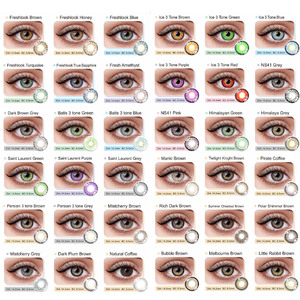
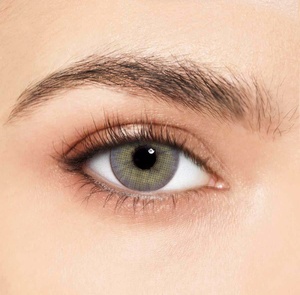
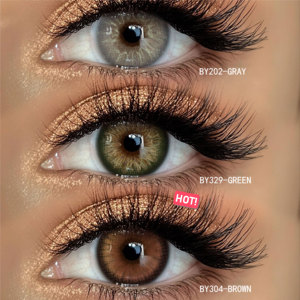
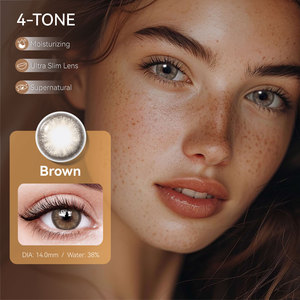
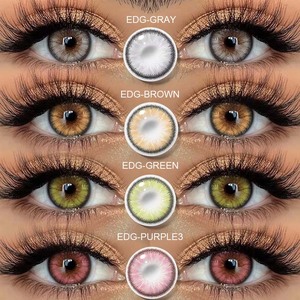
The undisputed volume driver for drugstores, optometry clinics, and direct-to-consumer beauty brands. Characterized by subtle limbal ring blending, 14.0 mm to 14.2 mm graphic diameters, and translucent color gradients (greige, hazel, olive, and ash brown).
- Optimal Base Curve: 8.5 mm - 8.6 mm universal fit.
- Water Content: 38% (anti-drying) or 42% balanced hydration.
- Primary Target: Asian & European daily commuters.
2. Cosplay, Anime FX & Sclera Lenses
High-margin theatrical lines designed for convention retail, theatrical SFX studios, and seasonal Halloween surges. Featuring completely opaque color blocking, vibrant pigments, and expanded diameter profiles ranging from 14.5 mm to full 22.0 mm coverage.
- Form Factors: 14.5 mm Standard FX, 17 mm Mini Sclera, 22 mm Full Sclera.
- Color Chemistry: High-density opaque pigments with clear pupil apertures.
- Wear Cycle: Daily disposable or half-yearly sterile vials.
3. Clear Rx Vision Correction
High-repeat recurring order foundation for prescription optical chains. Lenses feature aberration-control aspheric optics that minimize spherical aberration across low and high diopter ranges (-0.50D to -12.00D, plus hyperopic options).
- Transmissibility: Elevated Dk/t to satisfy clinical corneal requirements.
- Edge Geometry: Micro-tapered round edge for tear film circulation.
- Packaging: Multi-pack blister boxes with tamper-evident foils.
Engineering Parameters: OEM Manufacturing Matrix
A detailed breakdown of polymer dynamics, manufacturing specifications, and international standard verifications across our core production categories.
| Category Line | Base Material | Water Content | Diameter (DIA) | Base Curve (BC) | Dk/t (@ -3.00D) | Packaging Options |
|---|---|---|---|---|---|---|
| Natural Cosmetic Nuance | Poly-HEMA / NVP Copolymer | 38% - 42% | 14.0 mm - 14.2 mm | 8.5 mm / 8.6 mm | 16 - 22 × 10-9 | PP Blister Pack / Sterile Glass Vial |
| 3-Tone Transforming | HEMA + MMA Matrix | 38% - 40% | 14.2 mm - 14.5 mm | 8.6 mm | 15 - 20 × 10-9 | Blister with Custom Foil / Retail Box |
| Cosplay Theatrical FX | Cross-linked Hydrogel | 38% - 42% | 14.5 mm | 8.6 mm | 14 - 18 × 10-9 | 1-Pack / 2-Pack Sealed Vials |
| 17mm Mini Sclera | Hydrophilic Poly-HEMA | 38% | 17.0 mm | 8.8 mm - 9.0 mm | 12 - 16 × 10-9 | Hospital-Grade Sealed Glass Vial |
| 22mm Full Sclera | Bespoke Hydrogel Matrix | 38% | 22.0 mm | 11.0 mm (Scleral) | 10 - 15 × 10-9 | Heavy-Duty Sealed Glass Vial |
| Clear Vision Rx | HEMA-GMA / Ocufilcon D | 42% - 55% | 14.0 mm - 14.2 mm | 8.5 mm / 8.6 mm | 24 - 32 × 10-9 | Automated 30-Pack / 90-Pack Blisters |
Future Sourcing Trends: The 2025-2030 Contact Lens Landscape
Anticipating material transitions, sustainable supply chain mandates, and localized compliance architectures before placing capital commitments.
1. The Silicone Hydrogel Revolution
While conventional hydrogel (Poly-HEMA) remains dominant for cost-effective color printing, third-generation Silicone Hydrogel (SiHy) formulations are entering private label manufacturing. SiHy yields Dk/t ratings exceeding 80–120 × 10-9, completely preventing corneal hypoxia during 14-hour wear cycles.
2. Eco-Friendly Sustainable Packaging
B2B buyers face stringent European and Japanese packaging waste laws. Contract factories are migrating toward ultra-thin, recyclable polypropylene (PP) blister trays with 40% reduced foil weight, alongside FSC-certified soy-ink outer paperboard boxes, minimizing shipping carbon footprints.
3. High-Definition Digital Dot Matrix
Consumer preference has transitioned from artificial block printing to ultra-fine dot gradient printing below 25 microns. Modern automated pad-printing heads mimic the natural human iris stroma, seamlessly blending cosmetic color with darker native eye shades for undetectable wear.
4. Turnkey MAH Regulatory Dossiers
Regulatory barriers have intensified. Importers can no longer source from uncertified white-label workshops. Successful brands partner with tier-1 manufacturers capable of supplying full biocompatibility dossiers, DMFs, and testing files that expedite approval under Japan's PMD Act, EU MDR, and US 510(k).
Shenzhen Lensesgoo Co., Ltd: Manufacturing Scale & Commercial Precision
Combining advanced manufacturing technology in Shenzhen with international distribution infrastructure to empower optical entrepreneurs, beauty groups, and specialty importers.
Agile Inventory & 7-Day Fast Dispatch
Unlike traditional OEM optical mills requiring rigid 10,000-pair minimums per shade, we maintain an active warehouse holding hundreds of popular natural, Rx, and cosplay SKUs. Catalog orders dispatch within 7 business days, allowing new entrants to test regional channels with low capital risk.
Complete OEM/ODM Private Label Production in ~20 Days
For established retail chains and cosmetic brands, our engineering team executes end-to-end bespoke product lifecycles within ~20 working days. From custom graphic diameter patterning and diopter prescription sorting to primary blister foil heat-sealing and branded multi-pack packaging.
Comprehensive Japanese PMD Act & MAH Support
Japan represents one of the world's most rigorous Class III medical device markets. While Shenzhen Lensesgoo operates as the manufacturing source, we supply complete technical documentation, raw material certifications, and Japanese-language compliant artwork directly to your licensed Marketing Authorization Holder (MAH).
Comprehensive SFX, Theatrical & Sclera Specialization
We stand among the select few certified Chinese cleanroom manufacturers capable of engineering precision 17.0 mm Mini Sclera and 22.0 mm Full Sclera lenses. Each specialty lens is manually inspected under stereomicroscopes for edge curvature uniformity, tear duct clearance, and structural integrity.
Factory Quality Assurance: The 5-Stage Verification Standard
To guarantee end-user corneal safety and zero product liability claims, every batch leaving our automated facility passes five non-negotiable verification gates:
1. Optical Centration & Sagittal Fit
High-precision optical comparators measure center thickness, refractive index, and sag-depth against CAD master molds to eliminate prism distortion and fit instability.
2. Automated Optical Inspection (AOI)
100% of lenses pass sub-pixel automated machine vision scanners to identify micro-bubbles, peripheral edge notches, pinholes, or pigment misalignments before blister sealing.
3. High-Pressure Steam Autoclave
Sealed blisters and vials undergo validated terminal moist-heat sterilization (121°C for 30 minutes) ensuring an audited Sterility Assurance Level (SAL) of 10-6.
Frequently Asked Questions for Wholesale & OEM Sourcing
Authoritative answers concerning MOQs, regulatory approvals, sterilization protocols, and custom packaging workflows.
For in-house branded catalog designs, our MOQ starts as low as 50 to 100 pairs with flexible mix-and-match across colors and diopter prescriptions. For complete custom OEM/ODM packaging (custom outer boxes, blister foils, and brand collateral), initial MOQs generally start around 500 to 1,000 pairs depending on the degree of structural packaging customization.
We employ a proprietary three-layer "sandwich" casting technology. Pigment print patterns are deposited and enclosed within layers of raw hydrogel material prior to UV/thermal polymerization. This process guarantees that active colorants never physically touch the corneal tissue or tear film, eliminating pigment rub-off or toxic leaching over extended wear.
Yes. Under the Japanese Pharmaceutical and Medical Device Act (PMD Act), cosmetic lenses are classified as highly controlled Class III medical devices. We supply the comprehensive physical specification sheets, raw monomer breakdown sheets, cytotoxicity and biocompatibility reports (ISO 10993), and quality audit records required by your Japanese Marketing Authorization Holder (MAH).
All contact lenses are immersed in sterile buffered saline solution and undergo validated moist-heat steam autoclave sterilization at 121°C. Our multi-layer blister packaging and sealed medical-grade glass vials provide a validated shelf life of 5 full years from the date of manufacture when stored in clean, ambient conditions away from extreme heat.
We accept T/T (Bank Telegraphic Transfer), PayPal, Commercial Credit Cards, Western Union, and irrevocable L/C for high-volume container shipments. For logistics, we operate dedicated express corridors (DHL, FedEx, UPS) with guaranteed transit to Tokyo, Osaka, London, or Los Angeles within 3 to 6 business days, or air/ocean freight via your designated forwarder.
Absolutely. Sourcing managers, optometrists, and commercial brand buyers can request direct stock sample kits covering any specific color code, diameter, or water content series. Sample requests are processed and dispatched within 24 to 48 hours directly from our Shenzhen fulfillment center for evaluation.
Ready to Scale Your Contact Lens Line With Direct Factory Pricing?
Whether you require low-MOQ rapid stock fulfillment, bespoke graphic diameter design, or full-scale private label blister contract packaging, our optical engineering team is available 24/7 to structure your manufacturing schedule.